Blood, Sweat & Budget Cuts: Texas Horned Lizards Weather Heat
Amid federal funding slashes, a head-start program for Texas horned lizards strives to see another day in Oklahoma
- By Heide Brandes
- Conservation
- Sep 24, 2025
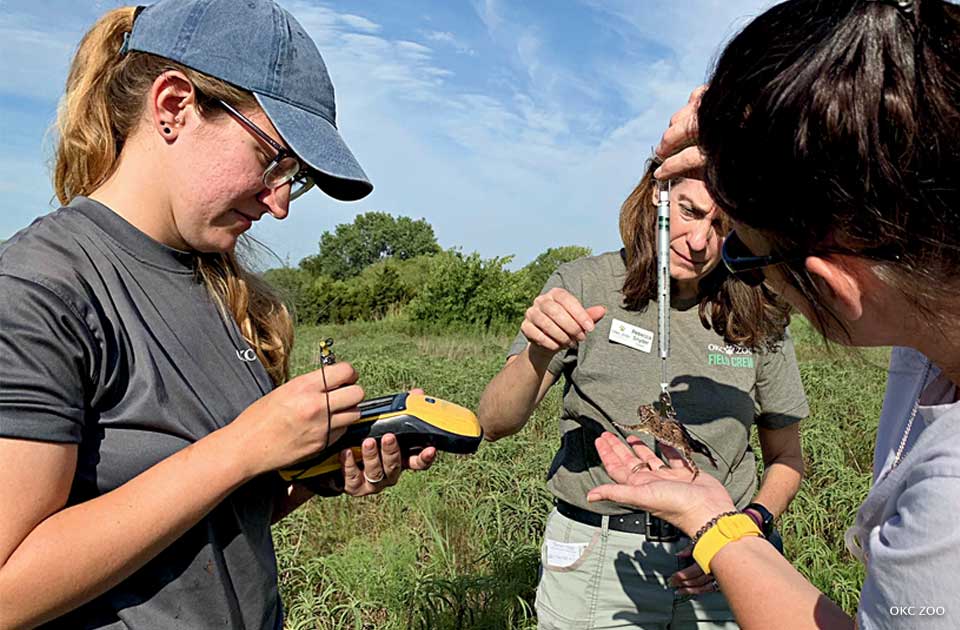
Oklahoma City Zoo team members inspect horned lizards at Tinker Air Force Base (above and below). The zoo had to scale down its transmitters, as Oklahoma lizards run a few inches smaller than those in Texas.
THE CRACKED RED EARTH OF TINKER AIR FORCE BASE bakes under the relentless Oklahoma sun on what will be the hottest day of 2025 so far. Heat shimmers rise from patches of native grasses that have managed to survive, lending to an atmosphere of hope and uncertainty on this May morning.
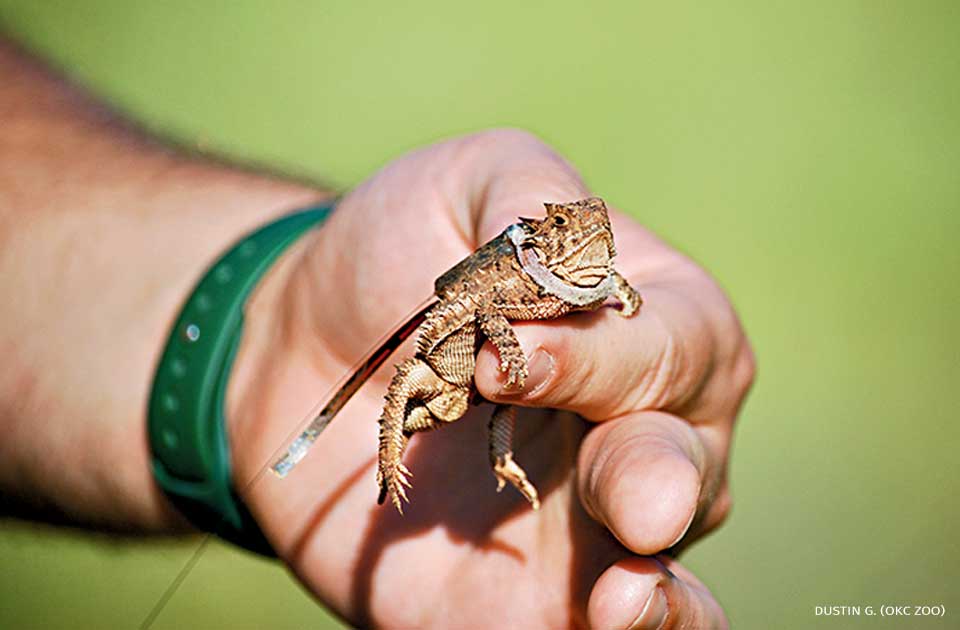
Blake Bauer kneels in the dust, carefully opening a small Tupperware container. Red, a 2-inch Texas horned lizard identified by a dot painted on his back and a miniature diode tracker attached to his spiny frame, blinks against the sudden brightness.
“This is the perfect habitat for him,” Bauer whispers. Red will have native bunchgrasses for cover, loose soil for burrowing and, hopefully, plenty of acrobat ants to eat. After some hesitation, Red scurries a few inches, his camouflage blending with the rusty soil. For Bauer, lead animal caretaker for reptiles and amphibians at the Oklahoma City Zoo, this bittersweet release carries extra weight. Red’s sibling, Blue, succumbed to an impaction in his gut just weeks earlier, making Red the sole survivor of this year’s horned lizard head-start program.
What’s more, Red might be one of the final releases. Federal funding cuts have left the future of the initiative in doubt.
A head start on survival
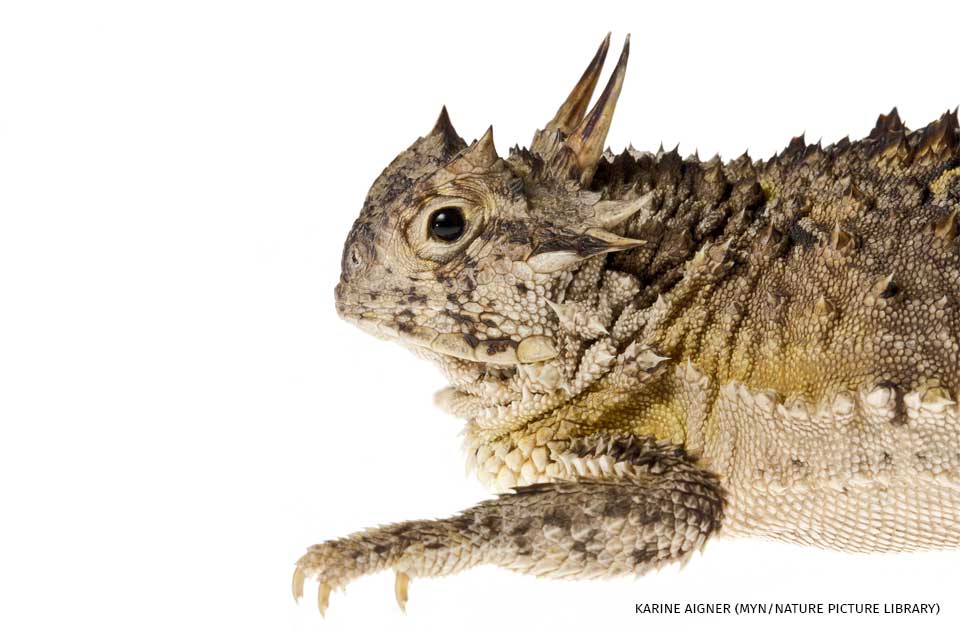
With their crown of horns and flattened, toadlike bodies, Texas horned lizards are icons of the Southwest, especially notable for their startling defense mechanism: When threatened by predators, they shoot blood from ducts in their eyes.
“They typically do it if a canine is nearby, like a coyote or a dog,” Bauer says. “They’ve never done it at us.”
Nicknamed “horny toads” and “horned frogs” (see “Crossword: Back to School,”), these lizards once roamed throughout Texas, across 80 percent of Oklahoma counties and as far north as Colorado. Due to factors including habitat loss, pesticides, the introduction of invasive species such as red fire ants that prey on horned lizard eggs and the collection of wild lizards as pets, they’re now classified as a species of greatest concern in Oklahoma and as threatened in Texas.
“You talk to some of the older people that grew up here, you mention horned lizards, and they go: ‘Oh, I used to see those all over when I was a kid. What happened to those?’” Bauer says.
Since 2008, the Oklahoma City Zoo has helped track and monitor lizards at Tinker in the longest continuous study of a Texas horned lizard population. In 2019, they added the ambitious head-start program.
“The idea was that the population at Tinker waxes and wanes. There seems to be more habitat available that would support a larger population than it does,” says Rebecca Snyder, senior director of conservation, education and science at the zoo. “Texas horned lizards are especially vulnerable when they’re eggs. Animals dig up the nests and eat the eggs or the tiny hatchlings.”
The head-start program—of which Red is lizard number 1,179—collects eggs and hatchlings from Tinker, raises them at the Zoo’s Lizard Lab until they grow past the vulnerable age of 1 or 2 and then releases them back at the base to bolster the wild population.
Results have been promising. Data show about 50 percent of the head-started lizards survive until the subsequent season. The program has yielded three peer-reviewed studies, including one that compared gut microbiomes between lizards in the lab and wild lizards living at the air force base. “Within a few months after release, their microbiomes became more similar to the wild lizards,” Snyder says. “That’s an indicator that they were adapting well.”
When funding dries up
In April, the program received the news that federal funding for Tinker’s role in lizard monitoring had been eliminated—a plight increasingly common in conservation circles. Without money to pay for tracking equipment or grad student researchers from The University of Oklahoma, the suspension came at a particularly difficult time, with only Red and Blue then awaiting release.
“Some years, we might find 20 babies or so, and then there are other years where we don’t find any,” Bauer says. “If conditions aren’t right, reptiles will say, ‘OK, this year is not a good year to breed.’”
Despite the setback, the Oklahoma City Zoo isn’t giving up. They’ve partnered with a local brewery, COOP Ale Works, that’s contributing 2 percent of sales from its Horny Toad Blonde Ale toward conservation efforts. And later this year, the zoo will establish a captive breeding program modeled after successful efforts at the Fort Worth and Dallas zoos. Tinker is just one of the possible release sites for future captive-bred lizards. “They think an influx of new genes could be good for that population,” Snyder says.
The importance of saving the Texas horned lizard extends beyond the species itself.
“A lot of other lizards, when humans encroach on their territory, they can live alongside humans in our backyards,” Bauer says. “These guys, everything has to be perfect. They need to have the right food sources, the right kind of habitat, otherwise they just disappear.”
He continues: “They’re really an indicator species of how the habitats are doing. If they’re not able to thrive in an area, that means something’s wrong with that habitat. If something’s wrong with them, that means things could go wrong with other plants and animals.”
Snyder agrees. “When you have a common species, something that’s so plentiful that people remember it was everywhere, and then it disappears, that is really worrisome,” she says. “That’s happening with a lot of species.”
Heide Brandes is an award-winning journalist in Oklahoma.
More from National Wildlife magazine and the National Wildlife Federation:
Learn more about NWF’s South Central Regional work »
Armadillos Are Full of Surprises »
From Our Archives: Wildlife Adaptations to Low-Water Environments »


