Cannupa Hanska Luger’s Ode to What Remains
Art is just the byproduct. Luger highlights how Indigenous ways of life could save the world.
- By Jennifer Wehunt // Art by Cannupa Hanska Luger
- Conservation
- Sep 24, 2025
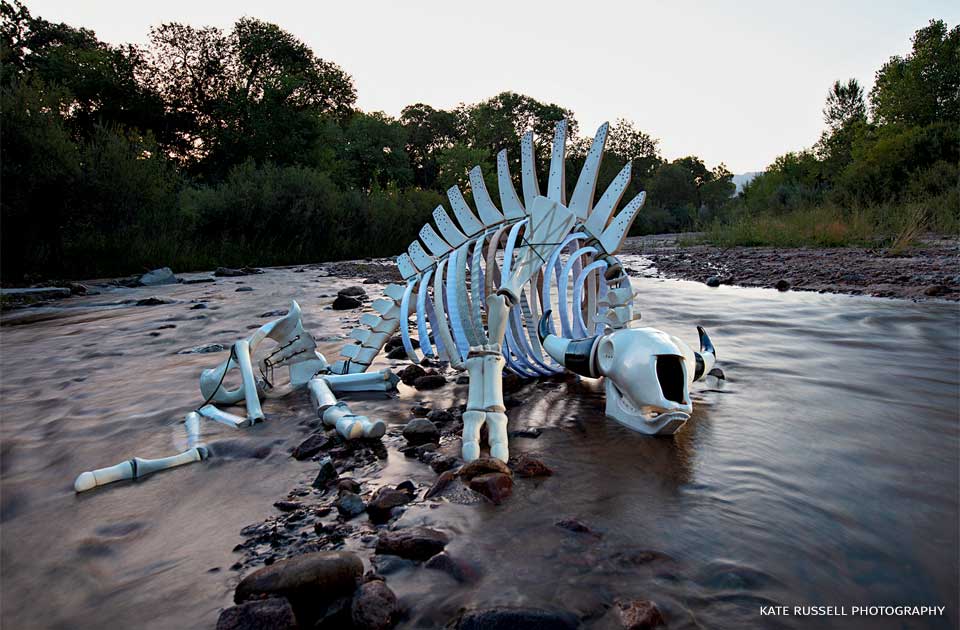
"(Be)Longing" is part of the permanent collection at the Hood Museum of Art, Dartmouth College.
CANNUPA HANSKA LUGER first installed the life-size ceramic and steel skeleton at the center of “(Be)Longing”—above, an artwork that also includes video—in a New Mexico riverbed for the 2019 exhibition Species in Peril Along the Rio Grande. He wasn’t only concerned with bison. “There is a direct correlation between the annihilation of buffalo and the subjugation of my population and our near annihilation,” says Luger, who was born on the Standing Rock Indian Reservation in North Dakota; is an enrolled member of the Three Affiliated Tribes of Fort Berthold; and is Mandan, Hidatsa, Arikara and Lakota. There were “tens of thousands of years of being in relationship with the landscape” before the forced removal of both buffalo and Indigenous ways of life, which would impact generations to come. Helping the public understand that big picture drives the New Mexico-based artist. “It’s not just a series of songs and dances,” he says of the role of Indigenous culture in today’s world. It’s guidance on how to take care of the world. “We’re willing to share that knowledge if it means we, collectively—human beings, plants, animals, environments—can thrive far into the future.” The artwork, he says, is “simply a conduit.” See more of Luger's work.
More from National Wildlife magazine and the National Wildlife Federation:
Our Work: Bison Restoration »
Forming a Bond: Behind the Scenes of 'A Buffalo Story' »
See Last Issue’s Featured Artist »


