Where Wildlife Collisions Happen
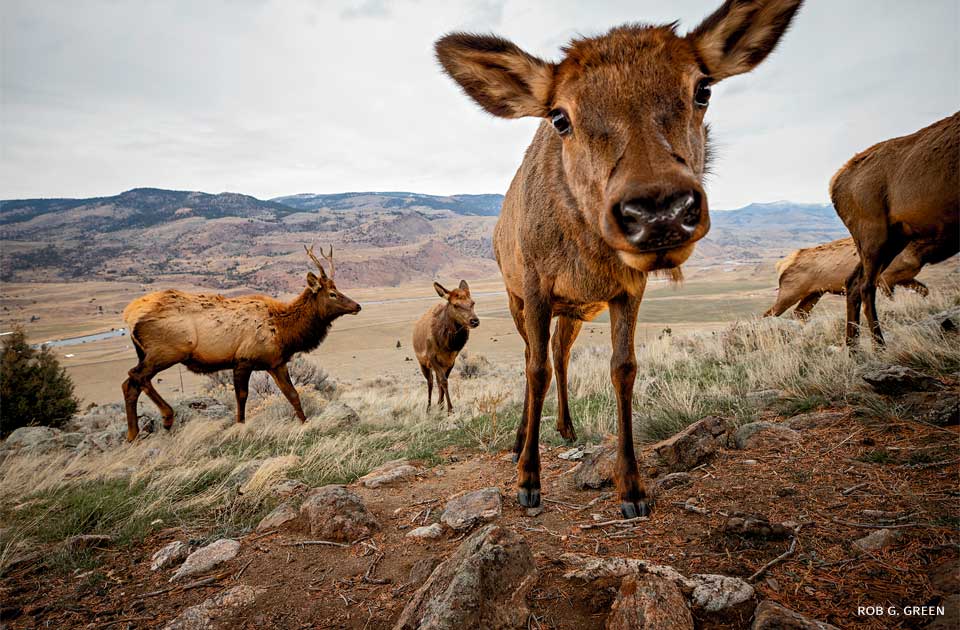
Wildlife and conservation photographer Rob Green set up a camera trap along a collision-prone highway near Yellowstone National Park
- By Delaney McPherson // Photo by Rob G. Green
- Wildlife Photos
- Sep 24, 2025
WORKING AS A BACKCOUNTRY GUIDE IN GUATEMALA, photographer Rob Green saw many human impacts on the environment firsthand. The experience led him to pursue a master’s degree in natural resource conflict resolution at the University of Montana. When the COVID-19 pandemic limited travel, he focused his lens on interactions close to home. “So many issues are universal,” he says. “Habitat fragmentation, biodiversity loss. These things are everywhere.”
From July to November 2023, Green set up a camera trap near U.S. Highway 89 in Livingston, Montana, leading into Yellowstone National Park, where wildlife-vehicle collisions are common. He got this shot of an elk calf on the very last day before he removed the camera.
“The young calf looking confused is a sadly accurate metaphor,” Green says. “In these places their ancestors have known for millennia, the landscape is changing faster than they’re able to naturally adapt.”
The group Yellowstone Safe Passages estimates there are more than 160 wildlife-vehicle collisions annually on the 54-mile stretch of Highway 89 between the towns of Livingston and Gardiner. Based on the time of day and where the trap was installed, Green suspects the elk were on their way to cross the highway, although their fate is unknown. See more of his photos.
More from National Wildlife magazine and the National Wildlife Federation:
Connecting Habitat for Migratory Species »
Efforts Are Afoot to Open Wildlife Corridors for Many of North America’s Iconic Species »
Blog: Wildlife crossings are a win-win »
See Last Issue’s Featured Photo »


