Is ‘Conservation Reliance’ a Life Sentence for Wildlife?
A growing number of imperiled species labeled conservation reliant depend indefinitely on labor-intensive and expensive human intervention to survive
- By Stephenie Livingston
- Conservation
- Mar 26, 2026
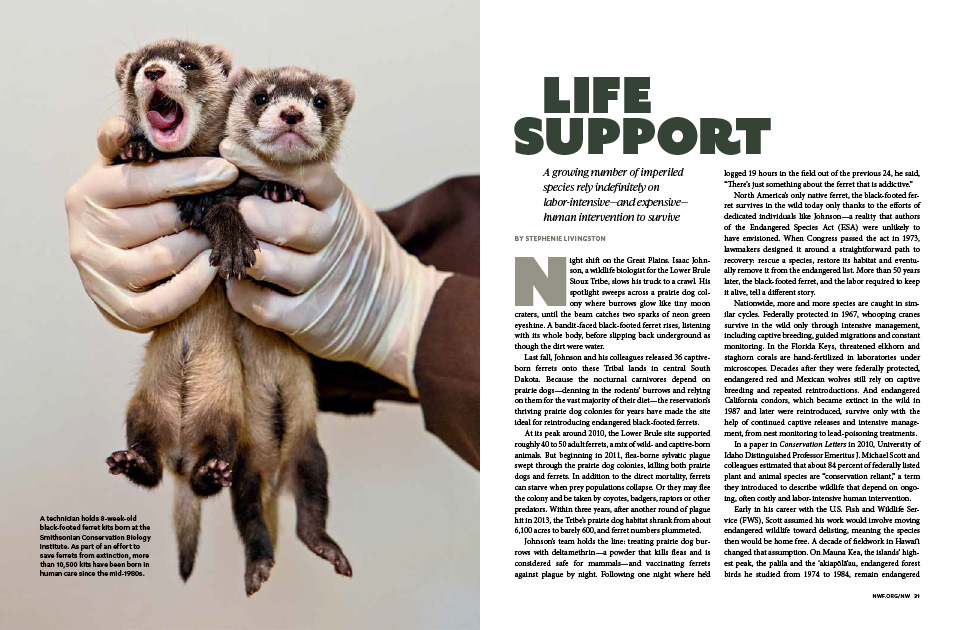
A technician holds 8-week-old black-footed ferret kits born at the Smithsonian Conservation Biology Institute. As part of an effort to save ferrets from extinction, more than 10,500 kits have been born in human care since the mid-1980s. (Photo by Suzi Eszterhas/Minden Pictures)
NIGHT SHIFT ON THE GREAT PLAINS. Isaac Johnson, a wildlife biologist for the Lower Brule Sioux Tribe, slows his truck to a crawl. His spotlight sweeps across a prairie dog colony where burrows glow like tiny moon craters, until the beam catches two sparks of neon green eyeshine. A bandit-faced black-footed ferret rises, listening with its whole body, before slipping back underground as though the dirt were water.
Last fall, Johnson and his colleagues released 36 captive-born ferrets onto these Tribal lands in central South Dakota. Because the nocturnal carnivores depend on prairie dogs—denning in the rodents’ burrows and relying on them for the vast majority of their diet—the reservation’s thriving prairie dog colonies for years have made the site ideal for reintroducing endangered black-footed ferrets.
At its peak around 2010, the Lower Brule site supported roughly 40 to 50 adult ferrets, a mix of wild- and captive-born animals. But beginning in 2011, flea-borne sylvatic plague swept through the prairie dog colonies, killing both prairie dogs and ferrets. In addition to the direct mortality, ferrets can starve when prey populations collapse. Or they may flee the colony and be taken by coyotes, badgers, raptors or other predators. Within three years, after another round of plague hit in 2013, the Tribe’s prairie dog habitat shrank from about 6,100 acres to barely 600, and ferret numbers plummeted.
Johnson’s team holds the line: treating prairie dog burrows with deltamethrin—a powder that kills fleas and is considered safe for mammals—and vaccinating ferrets against plague by night. Following one night where he’d logged 19 hours in the field out of the previous 24, he said, “There’s just something about the ferret that is addictive.”
North America’s only native ferret, the black-footed ferret survives in the wild today only thanks to the efforts of dedicated individuals like Johnson—a reality that authors of the Endangered Species Act (ESA) were unlikely to have envisioned. When Congress passed the act in 1973, lawmakers designed it around a straightforward path to recovery: rescue a species, restore its habitat and eventually remove it from the endangered list. More than 50 years later, the black-footed ferret, and the labor required to keep it alive, tell a different story.
Nationwide, more and more species are caught in similar cycles. Federally protected in 1967, whooping cranes survive in the wild only through intensive management, including captive breeding, guided migrations and constant monitoring. In the Florida Keys, threatened elkhorn and staghorn corals are hand-fertilized in laboratories under microscopes. Decades after they were federally protected, endangered red and Mexican wolves still rely on captive breeding and repeated reintroductions. And endangered California condors, which became extinct in the wild in 1987 and later were reintroduced, survive only with the help of continued captive releases and intensive management, from nest monitoring to lead-poisoning treatments.
In a paper in Conservation Letters in 2010, University of Idaho Distinguished Professor Emeritus J. Michael Scott and colleagues estimated that about 84 percent of federally listed plant and animal species are “conservation reliant,” a term they introduced to describe wildlife that depend on ongoing, often costly and labor-intensive human intervention.
Early in his career with the U.S. Fish and Wildlife Service (FWS), Scott assumed his work would involve moving endangered wildlife toward delisting, meaning the species then would be home free. A decade of fieldwork in Hawai‘i changed that assumption. On Mauna Kea, the islands’ highest peak, the palila and the ‘akiapōlā‘au, endangered forest birds he studied from 1974 to 1984, remain endangered today due to avian malaria and habitat-destroying introduced ungulates. Once a species is driven to the edge, he says, unless the threats can be removed, “it’s yours for life.”

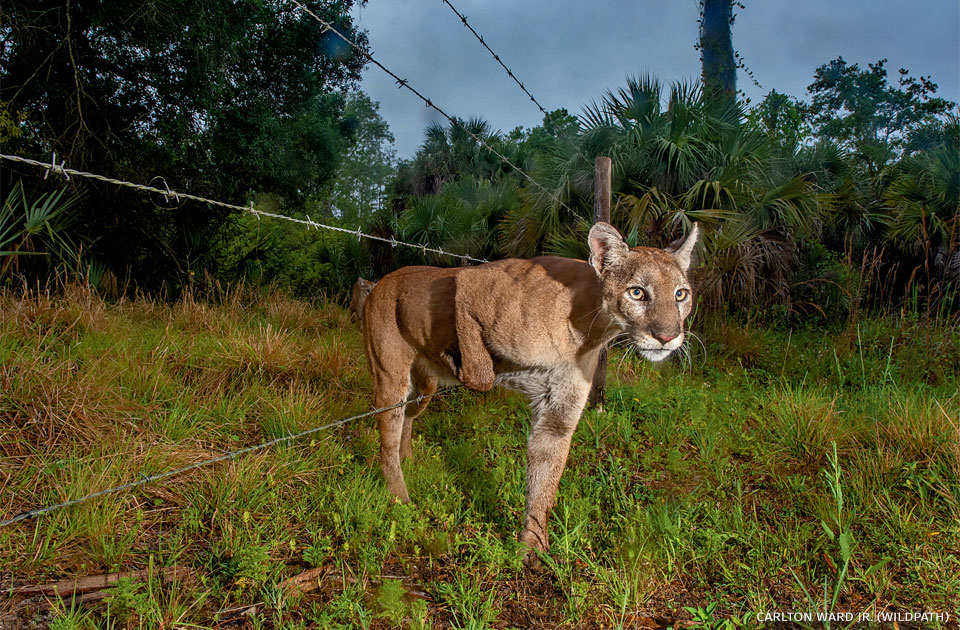
A female Florida panther steps through a barbed wire fence between a cattle ranch and the Audubon Corkscrew Swamp Sanctuary in Florida.
Second chances
Few species illustrate the labor-intensive and financially straining nature of conservation reliance better than the black-footed ferret. Living alongside Indigenous peoples for thousands of years, hundreds of thousands of ferrets once ranged widely from Canada to Mexico. But beginning in the 20th century, federal and state agencies mounted large-scale prairie dog eradication campaigns, often at the urging of ranchers who believed the rodents reduced forage for cattle (a claim considered overstated). Coupled with habitat loss, deliberate shooting and poisoning of the animals reduced their colonies to about 2 percent of their historic range. As prairie dog populations collapsed, so too did the ferrets’.
Meanwhile, another threat emerged: sylvatic plague, caused by a flea-borne bacterium that reached North America around 1900 on ships carrying infected rats. As the disease moved westward with the invasive rodents, plague rapidly began sweeping through prairie dog colonies, often killing more than 90 percent of the animals and wiping out the ferrets that depend on them. By the mid 1970s, the ferret had vanished from the wild—or so scientists thought.
Then, one morning in September 1981, a Wyoming ranch dog trotted home with a ferret carcass. Wildlife biologists who searched nearby rangeland discovered one tiny surviving ferret population. When plague and canine distemper swept through that population a few years later, FWS and the Wyoming Game and Fish Department brought all remaining animals into captivity. Of the 18 ferrets captured, only seven would prove viable breeders. Today, every known black-footed ferret alive descends from those seven individuals.
In the 1980s, FWS teamed up with state wildlife agencies, nongovernmental groups, Indigenous Tribes and accredited zoos to create a coordinated network that would breed ferrets in captivity and reintroduce captive-born animals to the wild. One partner alone, the Louisville Zoo, has produced more than 1,300 kits, about 800 of which have been released. Since 1991, federal and state agencies have reintroduced captive-born ferrets to more than 30 sites across eight U.S. states, along with two sites in Canada and Mexico.
Yet even a reliable pipeline of young ferrets and the vigilance of biologists like Johnson do not ensure ferret recovery—as the near collapse of the Lower Brule Sioux’s population shows. And as the threats to ferrets mount, the costs of recovery soar. In 2020, FWS reported spending some $1.3 million on federal and state black-footed ferret recovery actions, a figure that does not include additional investments by zoos, Tribes and nonprofits.
Johnson estimates he spent about $16,000 purchasing 50 cases of deltamethrin in 2025. How far do 50 cases go? “Not very far, I guess,” he says, adding that the greater cost is labor. Hiring workers even for the summer gets expensive quickly. “If I would have known what I know now,” he says, “it would have been hard to get started.”
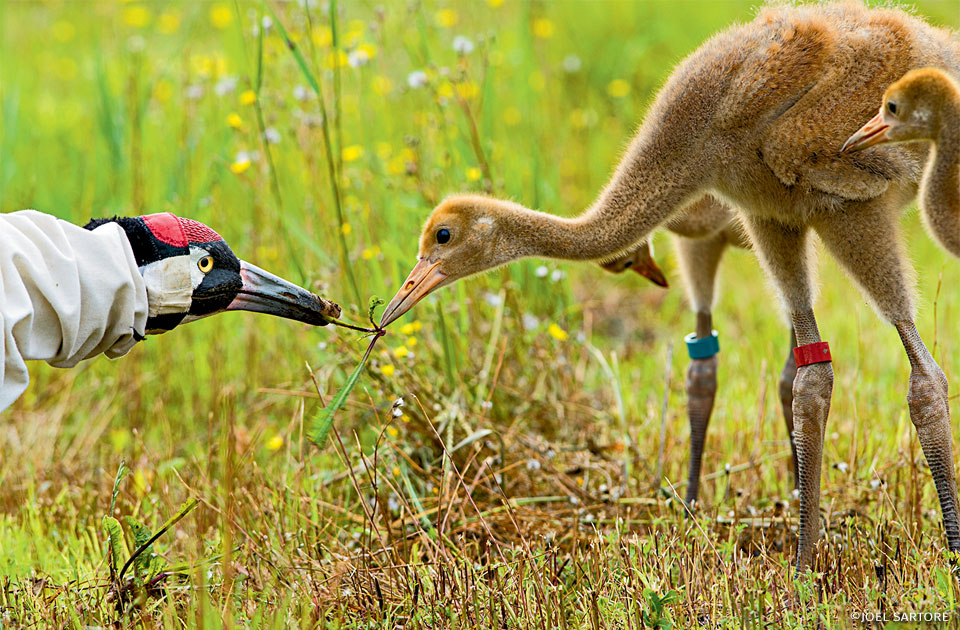
At the International Crane Foundation in Wisconsin, captive whooping crane chicks learn how to forage for food from a human trainer—disguised as a crane so the chicks do not imprint on people.
Rationing recovery
Many experts say the steep cost of recovering species is the most important reason so many remain conservation reliant. Nationally, ESA recovery spending has been running around $1 billion a year—but it’s not nearly enough. Princeton University ecologist David Wilcove, who has studied endangered species policy for more than 40 years, says that considering the level of investment needed, ESA has been on “a shoestring budget for as long as I can remember.”
As the list of imperiled plants and animals grows, the funding gap widens. “If you look at trends from the late 1990s to present, the amount of funding for recovery efforts on a per species basis has actually declined, once you correct for inflation,” Wilcove says. “We know how to save species,” he adds, “even ones that are very, very rare, but it is not, in general, a cheap process.”
The problem has worsened during the Trump administration. The White House’s fiscal year 2026 budget request sought roughly $1.1 billion for all FWS programs, about 30 percent below the 2025 enacted level. (By contrast, the administration’s defense request exceeded $1 trillion, roughly a 13 percent increase from last year.) While Congress rejected the most severe cuts, FWS has lost more than 20 percent of its staff since President Donald Trump took office.
Yet even when resouces are available and a path to recovery clear, some species remain conservation reliant because their recovery conflicts with politics or entrenched economic interests. The Mexican gray wolf is a prime example. Resurrected from a tiny captive population and reintroduced into the U.S. Southwest in 1998, it has clawed back from near extinction with the help of captive breeding and constant monitoring, as well as coordination among federal agencies, Tribes and conservationists on both sides of the U.S.–Mexico border. Biologically, the wolves have shown they can rebound. What continues to tie them to management stems from human choices: Many people, particularly ranchers, simply do not want wolves around. Confined to small, fragmented landscapes, wolves repeatedly are removed or killed after conflicts with livestock or political backlash.
“To me, the biggest story with the Mexican wolf is that they’re conservation reliant for a lot longer than they should be because of human intolerance,” says Mike Leahy, senior director of wildlife, hunting and fishing policy for the National Wildlife Federation. A similar dilemma has haunted endangered red wolves reintroduced to eastern North Carolina in the late 1980s after they had disappeared from the wild. While the situation is improving, the wolves routinely have faced local opposition, legal conflict and shifting federal policies that make funding unpredictable.
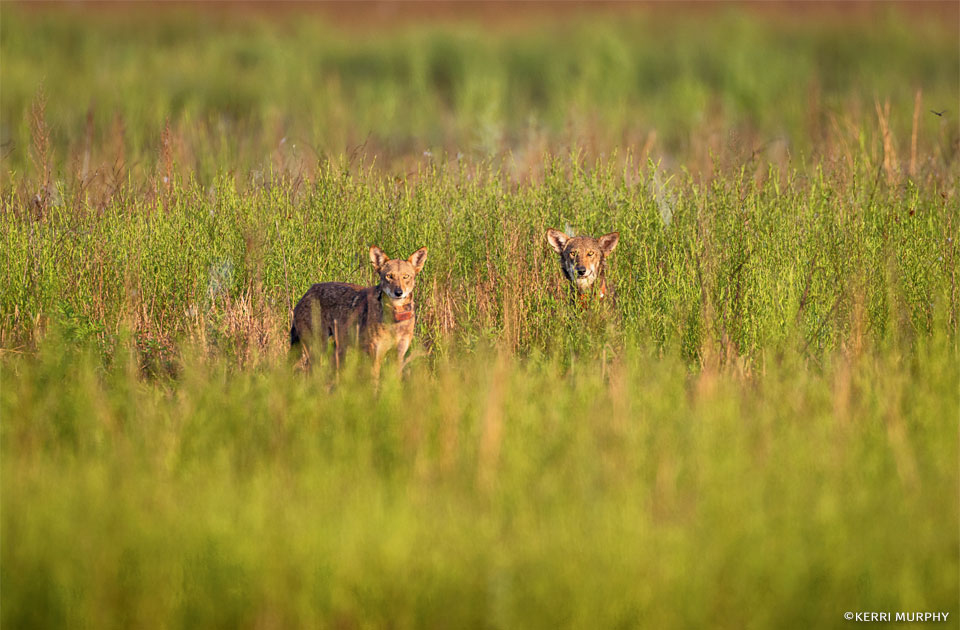
Red wolf siblings roam free in eastern North Carolina. Once extinct in the wild, the endangered wolves have been reintroduced to former habitat since the late 1980s.
Mounting threats
Many, perhaps most, conservation-reliant species are simply victims of what Leahy calls “the reality of the world we live in,” as habitat continues to be sliced, plowed, paved and dammed, leaving wildlife to survive in the ever-thinning margins that remain. As unprotected habitats shrink, they are degraded further by pervasive problems, from invasive species and climate change to pollution and disease.
The endangered Florida panther is a case in point. Once ranging across the entire Southeast, only one small population persists in southern Florida, where the cats’ habitat continues to be chopped into smaller bits by roads, new developments and other barriers. As panthers become more isolated from one another, inbreeding takes a toll. By the early 1990s, the population had collapsed to a few dozen animals showing signs of severe inbreeding. In what they termed a genetic rescue, wildlife managers introduced eight closely related female Texas cougars in 1995, which diversified the cats’ gene pool and allowed panthers to rebound to around 200 today.
But this single infusion of fresh genes did not solve the underlying problem of habitat loss fueled by urbanization and the state’s rapidly growing human population. In a 2025 study in the Proceedings of the National Academy of Sciences, researchers warned that gains in the panther’s genetic diversity may be temporary without further human intervention.
With its entire population descended from just seven individuals, the black-footed ferret also is at risk of inbreeding. Efforts to diversify its gene pool recently have grown complex. Using frozen cells collected in 1988 from a female, called Willa, who had never passed on her genes, scientists in 2020 produced a cloned ferret they named Elizabeth Ann. While she was unable to reproduce, a subsequent clone of Willa, Antonia, produced two kits in 2024. Last summer, Antonia and her descendants together gave birth to 12 more kits that will bring fresh genes into the ferret breeding program and help restore genetic variation lost decades ago.
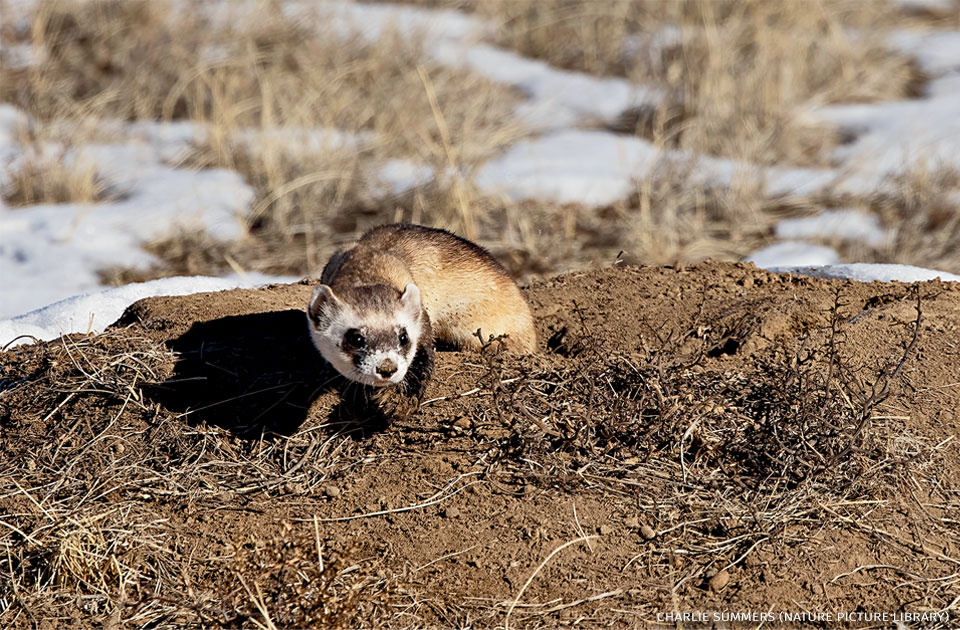
In Colorado, a reintroduced wild black-footed ferret emerges from a prairie dog burrow. Decades after gaining federal protection, both species still rely on human help.
A question of priorities
With a cost of approximately $6,000 per captive-bred ferret, some scientists say that when funding is scarce, prioritizing such expensive rescues can sideline species whose recoveries are more within reach. What worries Leahy is the species that never get much help at all, with hundreds of listed plants and animals receiving little or no funding. “A lot of these kinds of run-of-the-mill species,” from freshwater mussels to grassland songbirds, “just need maintenance and support,” he says.
Others argue that focusing resources on individual species makes little sense when the habitats and ecological processes they rely on are unraveling. A wiser priority, they say, would be to invest in efforts that address shared threats across landscapes, such as habitat loss, invasive species and climate change. Leahy believes it’s not a question of either-or. “We need healthy, intact ecosystems as well as the individual species that make them what they are,” he says.
Nor does he view conservation reliance as a failure, noting that most wildlife—including the majority of species, from ducks to trout, that are hunted or fished—require human management today. Certain imperiled species may need support for the “foreseeable future,” Leahy says, but that does not mean the work is misguided.
For Johnson, the effort has been well worth it—which is why he keeps returning to the South Dakota prairie, sweeping a beam of light across burrow mouths and waiting for the faint green flash that means ferrets are still there. Each kit that survives, each year without a plague collapse, gives him hope. And the work is beginning to show results. “We actually last fall caught [and vaccinated] the most ferrets that we’ve caught since plague moved through the first time,” Johnson says. “That was really encouraging, to see that our efforts are making a difference.”
NWF Priority
Protecting Imperiled Species
The National Wildlife Federation promotes endangered species recovery through its work to defend, strengthen, fund and ensure effective implementation of the Endangered Species Act. Learn more.
Stephenie Livingston is a Florida-based science writer.
More from National Wildlife magazine and the National Wildlife Federation:
40-Plus States Submit Wildlife Action Plans This Fall. Here's What That Means. »
The Endangered Species Act at 50 & What’s Next for Wildlife »
Charting the Real Toll of Bird Flu »


