Janet Echelman’s Monarch Rest Stop Is Worth a Visit
Echelman’s artwork ‘Butterfly Rest Stop,’ installed 65 feet above a North Texas plaza, fuels monarch migration and human imagination
- By Jennifer Wehunt // Art by Janet Echelman
- Conservation
- Mar 26, 2026
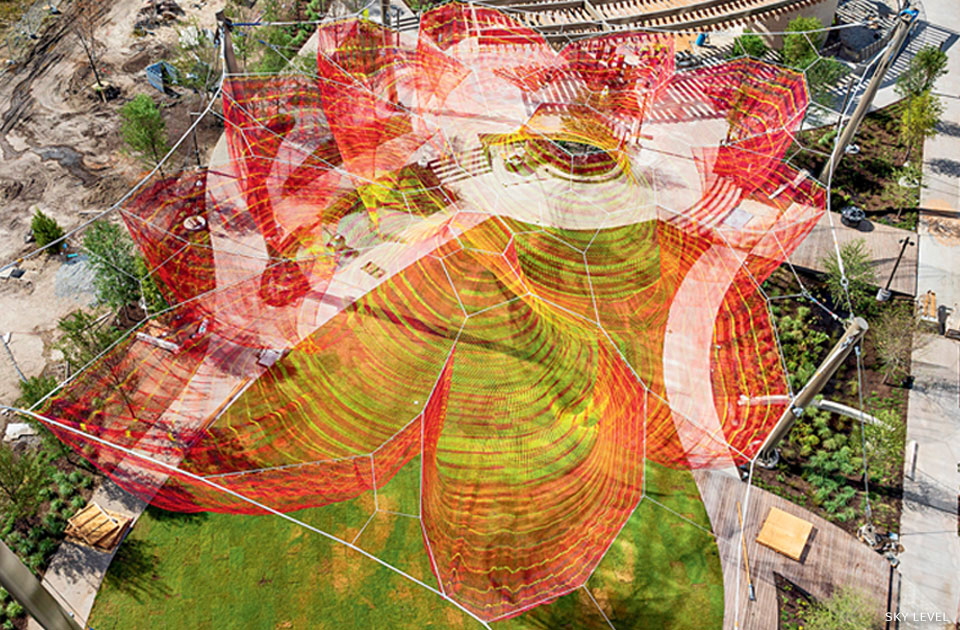
GIVEN THE ARTIST JANET ECHELMAN’S USE OF CUTTING-EDGE TECHNOLOGY, from proprietary modeling software to synthetic fiber 15 times stronger than steel, she could be assumed to prioritize evolution over reflection. That would be missing half the story. For 2024’s “Butterfly Rest Stop,” installed 65 feet above Frisco, Texas, the Studio Echelman cadre of engineers and artisans sought to push boundaries, for sure. The 165-foot-long work of nearly 800,000 knots marks the first time the team has integrated living plants into a sculpture: thousands of plugs of milkweed, among other pollinator-friendly species. But the piece—inspired by migrating monarchs that pass through on the way to and from their winter home in Mexico—serves as a literal way station, offering the insects a place to stop and refuel and humans a chance to pause and ponder. “Part of the experience is thinking about how another organism sees the world,” Echelman says. Every five years, the sculptural netting will be recycled, in keeping with the studio’s commitment to sustainability. Unlike clear glass, “Birds can easily see our sculpture, so they do not collide with it,” Echelman says, citing no avian injuries in 20 years of installations. She hopes the work underscores “how our human future is completely dependent” on pollinators, without whom “we would cease to exist.” See more of her work.
More from National Wildlife magazine and the National Wildlife Federation:
Migrating Arts »
Pollinator Gardens Bring Monarchs—and Joy—to a Texas Town »
See Last Issue’s Featured Artist »


