Knock Knock. Who’s There? The Ivory-Billed Woodpecker. Still.
Why does the possibly extinct ivory-billed woodpecker retain such a hold on fans' imaginations?
- By Andrew Sharp
- Conservation
- Jun 24, 2026
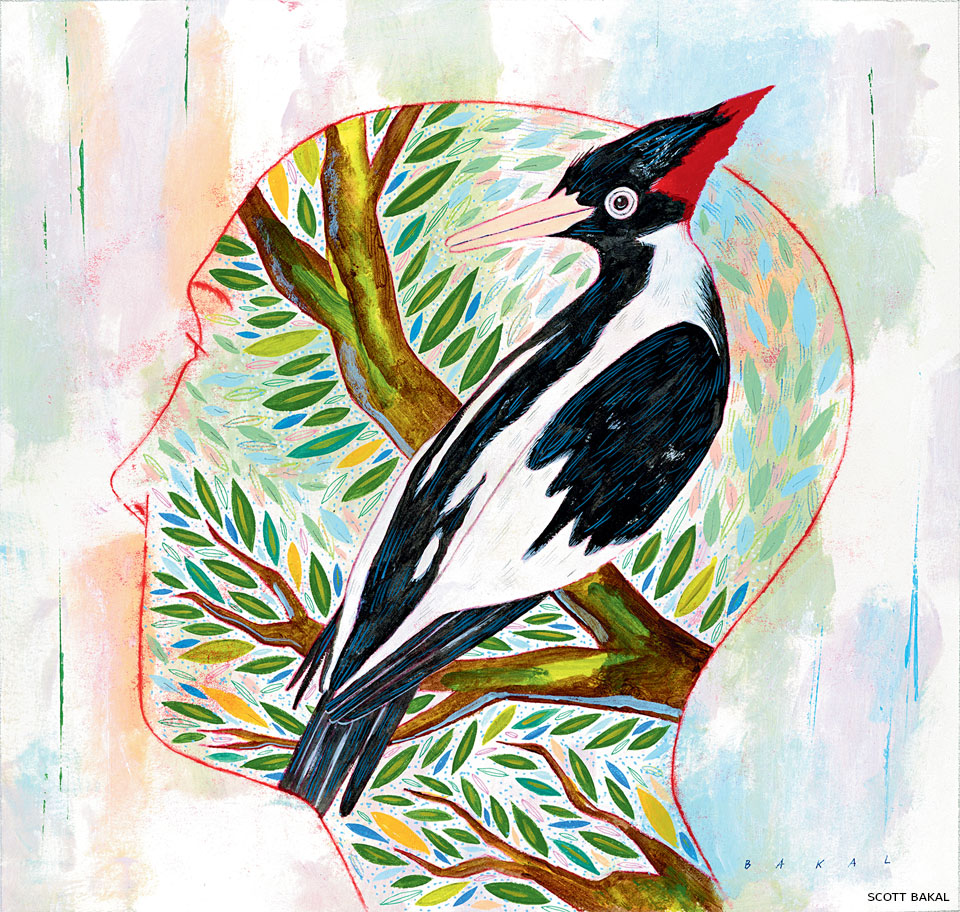
Illustration by Scott Bakal
AS A KID, Sylvie Németh loved the search for mysterious creatures, real or disputed. “I live in Seattle, so Bigfoot is huge here,” she says. When she was about 11, she was thrilled to learn the ivory-billed woodpecker, presumed extinct in the United States by many since roughly the 1940s, reportedly had been spotted in 2004 in the forests of Arkansas.
While those accounts came from such credible sources as Tim Gallagher, the longtime editor of Cornell Lab of Ornithology’s Living Bird magazine, most scientists are skeptical that the crow-sized bird, slightly larger than the similar-looking pileated woodpecker, still exists. Subsequent searches organized by Cornell turned up no definitive evidence. Even so, the frenzy hasn’t died down since.
Whether or not the species remains somewhere in its historical range of southeastern forests and swamps, it’s very much present in the Facebook group “The Ivory-Billed Woodpecker—Rediscovered.” Since 2011, the group has swelled to more than 23,000 members who ardently dissect proof of birdlife or lack thereof, debate the rationality of belief and share their favorite ivory-bill art. Why? What drives their obsession?
“Something about the concept of a species that we thought was extinct maybe being rediscovered was so exciting to me,” says Németh, a member of the Facebook group and a onetime biology major who now works as a recruiter. She delighted in reading The Grail Bird, Gallagher’s 2005 book on decades of sightings, including his own, and in playing detective herself, examining purported online footage of the bird frame by frame. Although she’s not so sure about the bird’s existence anymore, she still sifts through grainy photos from time to time, lured back by the possibility of finally seeing the real thing.
Nicholas Mason, curator of birds at the Louisiana State University Museum of Natural Science, isn’t holding out much hope. He sees the chances of the bird’s survival as minuscule, given all the effort and time that has gone into searching.
“I would say, from the scientific community, the consensus is that it’s probably extinct,” he posits.
Chuck Hunter, a former U.S. Fish and Wildlife Service biologist, takes a more agnostic stance. A go-to expert on the woodpecker during his career, he has become a respected voice of the Facebook group in his retirement, sharing commentary that steers down the middle of the debate.
“I see legitimacy on both sides of the argument, but at the same time, it’s a mystery,” he says. “And I think it just requires [us] to have an open mind to see what we can figure out, and maybe we’ll be able to resolve it eventually.”
The journalist John O’Connor, author of The Secret History of Bigfoot, sees a similar wistfulness in woodpecker searchers and those looking for cryptids such as the Loch Ness Monster, although he notes that professional ornithologists are trained scientists, while Sasquatch watchers tend to be hobbyists less concerned with evidential rigor. Still, he understands the allure.
“If you look at a map and the real wilderness that’s left in this country, you’re looking at really just a couple of pinpricks,” he says. For ivory-bill territory, in particular, “there’s hardly an area in the United States, maybe with the exception of the Pacific Northwest, that’s been more devastated by logging.” For O’Connor, the idea that there’s more wildness out there than science has accounted for is a big part of the appeal to keep looking.
Susan Clayton, a conservation psychologist and a professor at The College of Wooster, agrees that people value mystery in a landscape: “a sense there’s something not fully apparent to the eye that you might learn if you explore further.” She also cites other motivations for ivory-bill yearning: the desire to be the one in the crowd who knows something others don’t, as well as an evolutionary need to connect with animals and nature.
Those fascinated with lost species may also be grieving humans’ impact on the natural world and feel an urge to ease that guilt.
“If the birds still exist,” Clayton says, “It’s like, ‘Yes, we didn’t break nature.’”
As Németh puts it, the end to ivory-bills “just shakes people as a particular loss, especially one … so closely tied to deforestation. It feels like a tragedy. It feels like something you look at and you think, ‘God, how could humans have done that?’”
In the midst of an era scientists call the sixth mass extinction, one bird is hardly unique. “We’re losing species every day,” Mason says.
And yet, few of those get an elegy on par with the ivory-billed woodpecker. A 2022 study in IBIS: International Journal of Avian Science estimated that searchers spent nearly 579,000 hours in pursuit of the ivory-bill from 2004 to 2021 and that state and federal sources directed more than $20 million—with a significant portion going to land purchases—toward the bird between 2005 and 2013.
Of less-heralded vanishers, “Many of those species are undescribed,” Mason says. “They’re insects or things that are small and maybe are overlooked. But [the ivory-bill] is a species that is large and charismatic and close to home. A lot of people, it hits them hard to think that this thing is gone.”
Andrew Sharp is a freelance writer based in Delaware.
More from National Wildlife magazine and the National Wildlife Federation:
Thomas Deininger Turns Waste & Doom Into Wildlife Art »
How Hula Is Shifting Alongside Hawai‘i’s Endangered Species »
Blog: NWF Acts to Stop the Silence of Extinction, So Should You »


