Making Your Yard a Haven for Nesting Birds
How to create safe places for backyard songbirds to raise their young in your yard or garden
- By Rebecca Heisman
- Conservation
- Jun 24, 2026
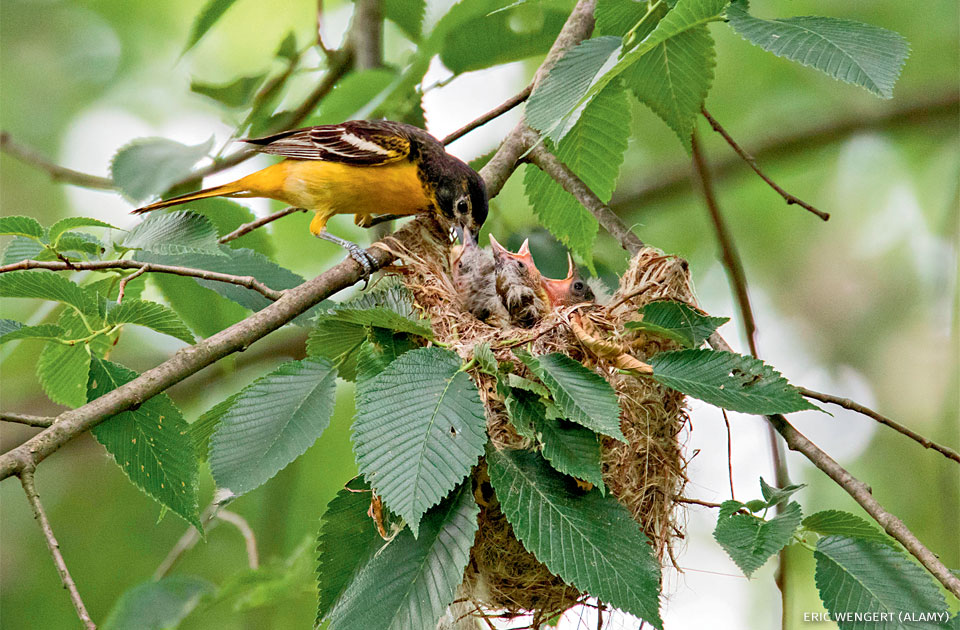
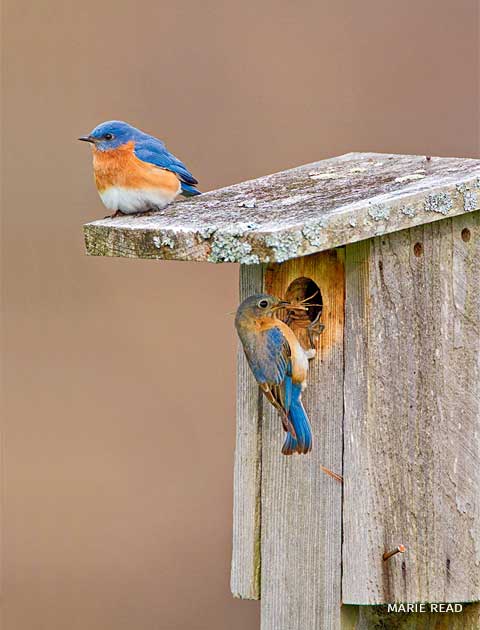
A Baltimore oriole, which nests in the tree canopy, feeds insects to its chicks in Michigan (above). Cavity-nesting species, such as bluebirds (below), will nest and raise young in birdhouses.
DO YOU LOVE WATCHING CARDINALS, chickadees and other songbirds in your yard? To increase your pleasure, consider encouraging the birds to stick around to nest and raise their chicks.
Depending on species and where you live, songbirds can nest anytime between March and August. Many of the basics for catering to them are the same as for all wildlife gardening. By providing food, water, cover and places to raise young and adopting sustainable gardening practices—the core tenets of the National Wildlife Federation’s Certified Wildlife Habitat® program—you can give birds what they need to nest safely, feed their babies and evade danger. Here are some specific suggestions.
The nest. Birds won’t nest in your yard if there aren’t appropriate places to build nests. For most backyard birds, this means trees and shrubs. While birds like wrens prefer to nest in dense bushes within a few feet of the ground, others, such as orioles, make their nests in the tree canopy. Depending on your region, trees and shrubs to consider include native dogwood, serviceberry, inkberry holly and black chokeberry. If your yard consists mostly of grass, “start planning on adding more woody plants,” says NWF’s naturalist, David Mizejewski.
Trees and shrubs, along with nonwoody grasses and flowering plants, also produce materials for nest construction, including twigs, dried grass and soft plant fluff—what’s inside a milkweed seed pod, for example. You can supplement natural nesting materials with short bits—no longer than 6 inches—of natural-fiber string or twine or hair from pets that haven’t been treated with flea or tick repellents. Scatter such items on branches or stuff them into unused suet feeders. Avoid human hair (too thin and fine), dryer lint (too absorbent and contaminated with detergent residue) and artificial materials like tinsel.
For cavity-nesting birds—including bluebirds, chickadees, wrens and tree swallows—birdhouses can supplement tree holes that may be in short supply. Because different species require different-sized boxes and entrance holes, do a little research before buying or building a nest box. Place your boxes at the right height for the intended species and consider the surrounding habitat. Bluebirds, for instance, readily take to nest boxes, but because they forage in open environments, they won’t use a box placed among dense trees.
It’s important for nest boxes to have ventilation and drainage holes so that fresh air can flow in and moisture can get out. And make sure your box has a side that swings on a hinge so you can monitor for nuisance species, such as nonnative starlings and house sparrows, and can clean it between nesting seasons. The latter is particularly important. “You can’t just set [a nest box] out there and then forget about it,” says Desirée Narango, a biologist with the Vermont Center for Ecostudies. An unsanitary nest box is unwelcoming and can spread disease. (See more nesting box tips.)
Food for baby birds. Baby birds need to eat a lot to successfully fledge. That’s one reason why the trees, shrubs and other plants you choose for your yard should be primarily native species that support insects—essential protein for growing chicks. “Ninety-six percent of our upland terrestrial birds, which is basically all of our backyard birds, feed their babies a diet of invertebrates,” Mizejewski says. Because native plants share a long evolutionary history with North America’s insects, they support these invertebrates in ways that nonnative plants do not.
Mizejewski specifically recommends oak trees, which host an incredible diversity of moth caterpillars—the perfect baby bird food. Native oaks can support as many as 550 different caterpillar species, while nonnative ginkgos, for example, support zero. (Learn what plants are native to your region.)
A safe haven. Two of the top killers of songbirds in North America are window collisions and outdoor cats, which together kill billions of birds a year. Take steps to make your windows as bird-friendly as possible. (Read more about preventing bird strikes.) If you own a cat, keeping it indoors is safest both for your kitty and the birds—especially during baby bird season. Shrubs and understory plants can help by providing shelter from predators, both feline and native, that neatly mown grass does not.
What if you spot a baby bird that might be in trouble? First, remember that not every baby outside a nest is an emergency; it depends on its age. If you find a mostly naked chick on the ground, gently return it to its nest. It’s a myth that bird parents will smell humans and reject the chick. Young, fully feathered birds, on the other hand, often hop out of the nest before they’re ready to fly, and, in most cases, their parents can tend to them on the ground with no problems. “Rescuing” a baby bird that doesn’t need help is harmful, because it’s likely to die without proper care and feeding from its parents.
Meanwhile, continue observing the bird family—and consider submitting those observations to NestWatch, a community science program run by the Cornell Lab of Ornithology. Your contributions will join a database vital to bird researchers exploring questions such as factors that determine nest success.
“Get your binoculars out and see what’s there, because often you find really exciting and also vulnerable species in residential yards,” Narango says. And with a few tweaks, you can turn your yard into prime bird-family habitat.
Rebecca Heisman is a bird-loving freelance science writer based in Walla Walla, Washington.
More from National Wildlife magazine and the National Wildlife Federation:
How to Prevent Bird Strikes at Home »
Who Really Benefits from Bird Feeders? »
Blog: Six Ways to Support Wild Birds at Home »


