Copepods Inhabit 70% of the Planet. What Are They?
Found in large numbers everywhere there is water, tiny zooplankton called copepods play essential roles in aquatic ecosystems, especially the oceans
- By Avery Schuyler Nunn // Photos by Angel Fitor
- Wildlife Science
- Jun 24, 2026
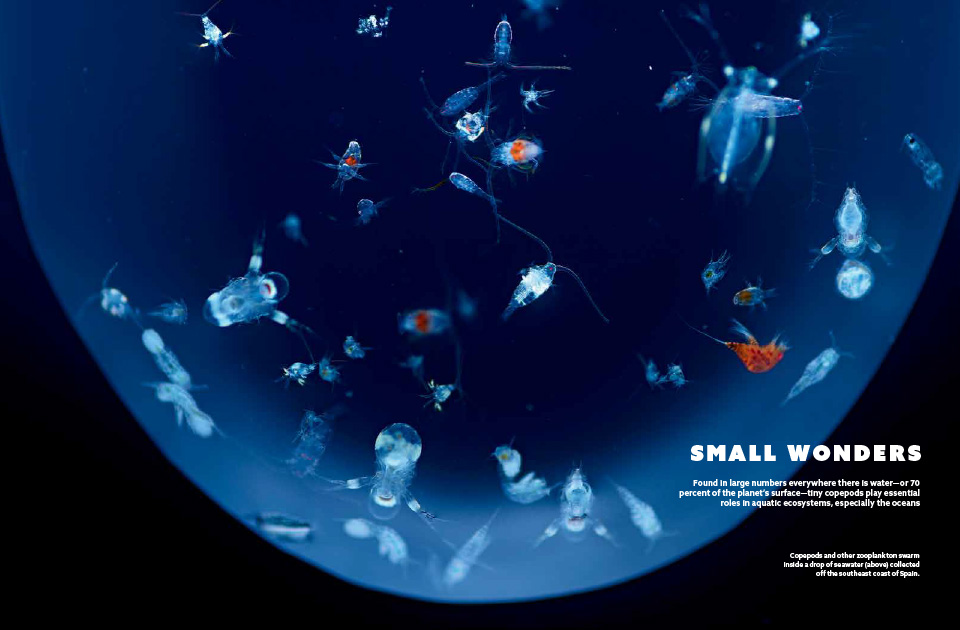
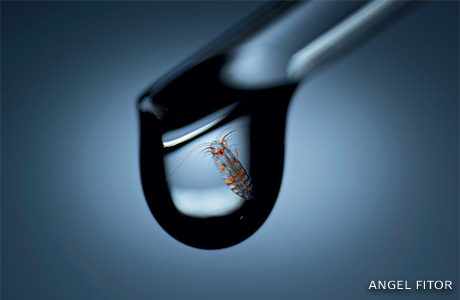
Copepods and other zooplankton swarm inside a drop of seawater collected off the southeast coast of Spain (above). A Calanus copepod (below) is suspended in a drop of water in the photographer’s lab.
AS THE SUN SLIPS BELOW THE HORIZON EACH EVENING, trillions of animals emerge from the ocean’s depths and begin an upward journey that has unfolded at nightfall for hundreds of millions of years worldwide. From the dark safety of deep water, these creatures—from microscopic plankton to krill, shrimp, squid and jellyfish—ascend toward the sea’s surface, drawn upward by hunger and instincts older than those of the dinosaurs. This nightly ascent, known as the diel vertical migration, is the largest animal migration—and largest recurring movement of biomass—on Earth.
The vast majority of these migrators are tiny animals collectively called zooplankton. Zooplankton ascend to shallow waters to feed on other smaller zooplankton and on phytoplankton, microscopic plantlike organisms that, by day, convert sunlight to energy through photosynthesis in the upper several hundred feet of water where sunlight penetrates.
“All the photosynthesis happens near the surface, so that’s where the food is,” explains James Pierson, a zooplankton ecologist at the University of Maryland. When the sun rises, zooplankton descend back into darker waters to evade predators that rely on sight. They rise again the following sunset to graze where the phytoplankton thrive.
Marine zooplankton make up a world where entire communities of life are contained in a single drop of seawater. Yet it is their lives, multiplied by the trillions, that fuel marine food webs, recycle vital nutrients and help govern the exchange of carbon between the ocean and the atmosphere.
Despite their importance, plankton—both photosynthetic phytoplankton and the zooplankton that feed on them—often are considered scenery: an abstract haze beneath whales and fish rather than the system that makes those animals possible. Plankton “are the foundation—ecologically and chemically—of life in the sea,” stresses Ellen Umeda, a plankton specialist, fisheries biologist and senior aquarist at the Monterey Bay Aquarium.

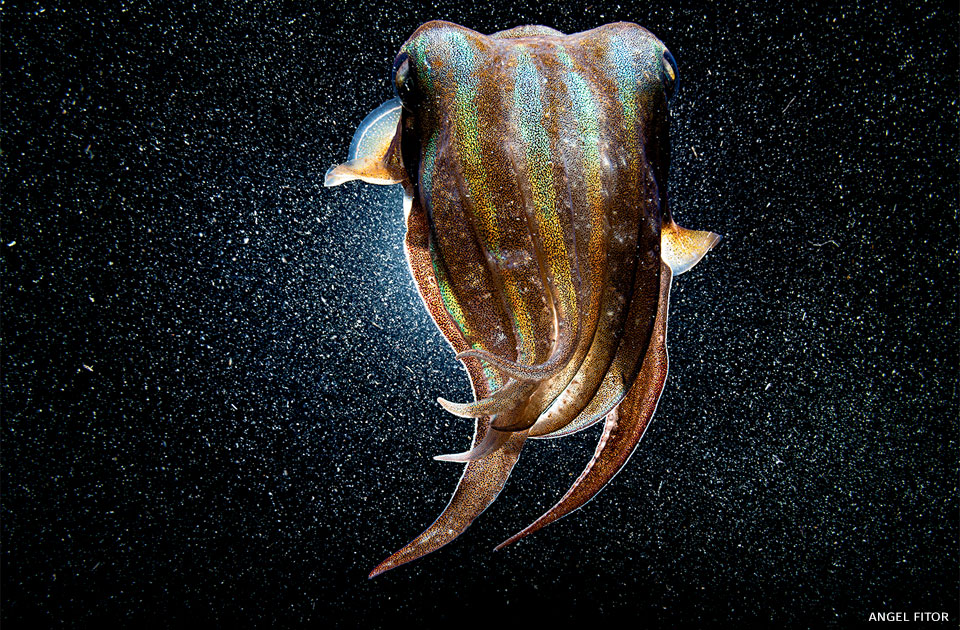
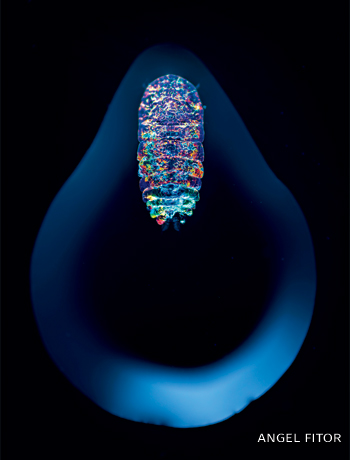
A common cuttlefish (pictured) swims amid zooplankton in the Mediterranean Sea. Such animals are among trillions that join the diel vertical migration that begins each night at sunset. A male Sapphirina copepod (below) glows in brilliant colors to attract a mate. Commonly called sea sapphires, these striking copepods generate their shine using iridescent plates that reflect sunlight. When not displaying, the males are translucent, as are females.
Copepods as keystones
Of all the zooplankton that make up the diel vertical migration, none are more numerous—and more vital—than copepods: teardrop-shaped crustaceans with large antennae that range in size from microscopic to roughly a grain of rice. Found everywhere on the planet where there’s water—from high mountain lakes and ponds to deepwater marine trenches and underground caves—“copepods are the most numerous group of animals on the planet,” says Chad Walter, an emeritus researcher at the Smithsonian’s National Museum of Natural History who has studied the animals since 1982. “People think insects are the most abundant animals, but water covers 70 percent of the planet, from 2 miles up to 6 miles down.” And in all those places, he adds, you will find copepods.
According to Walter, scientists have identified more than 15,000 copepod species, with many more still to be discovered. Their lifestyles are as diverse as their sizes and shapes. While the majority swim freely through water, others live in, on or under the sediment or on plants or other animals. One species has specialized to swim into the uterus of a shark, attaching itself to her pups before they are born.
The animals’ numbers are unimaginably huge. Even the most conservative estimates are astronomical. In a widely cited calculation, the copepod expert Geoffrey A. Boxshall assumed one copepod per liter of seawater worldwide—likely a significant underestimate—and still arrived at a global population of about 1.3 sextillion animals.
Given this abundance, along with their ubiquity, copepods play outsized roles in aquatic ecosystems. In the oceans, “they are the animals that convert plant material into animal material, forming the basis of all marine food chains,” Walter says. Consumed by creatures as large as baleen whales, copepods are particularly important food for larval fishes, he says.
The animals also play key roles in nutrient and carbon cycling. By feeding on phytoplankton near the ocean’s surface, they take in nitrogen and phosphorus, shuttling these elements to deep water where other creatures assimilate the vital nutrients by consuming copepods, living or dead, and their waste products. Likewise, feeding copepods incorporate carbon—captured by photosynthesizing phytoplankton as carbon dioxide from the atmosphere—and carry it to the deep ocean where the portion not consumed by other animals can be sequestered. This removes from the atmosphere some of the carbon dioxide released from fossil fuel combustion and deforestation.
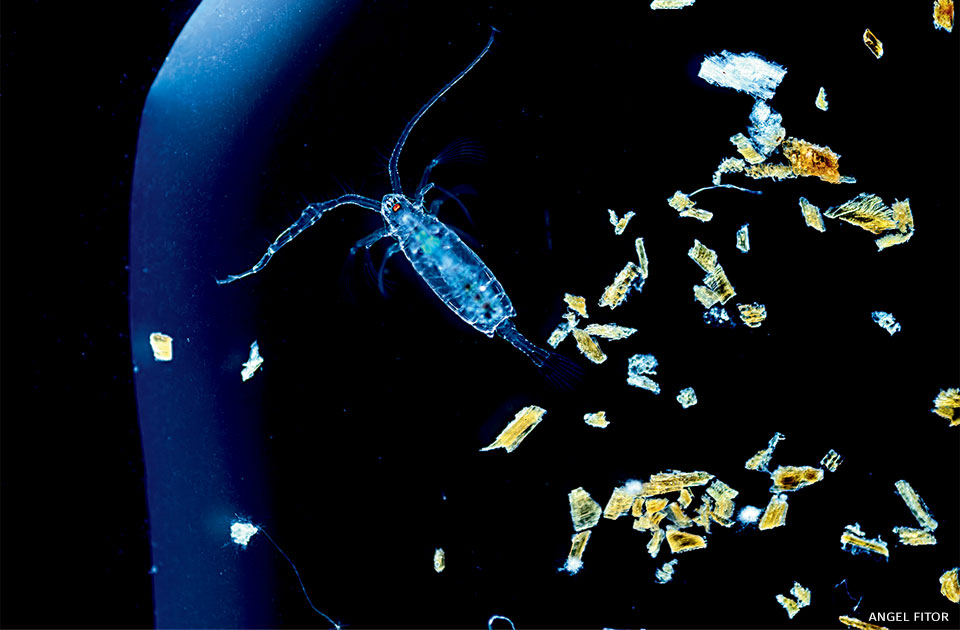
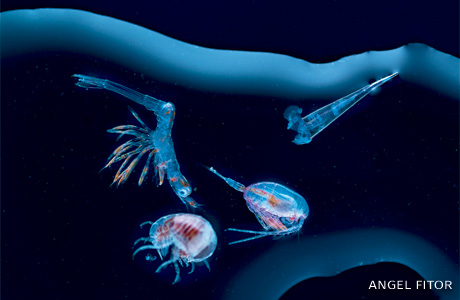
Plastic fragments, such as these surrounding a copepod (pictured), threaten entire food webs. A seawater sample in the photo below includes a copepod (bottom-right organism pictured) and other zooplankton.
Confronting an array of threats
Like all ocean life, marine copepods face many threats, from climate change to pollution and invasive species. Because the animals are small and poorly studied in the wild, little is known so far about the impacts of such threats. Walter is particularly concerned about nanoplastics, microscopic plastic particles that are ubiquitous in the oceans. Copepods ingest the plastic particles, he says, with impacts on their digestive systems. When incorporated into the animals’ bodies, the plastics—similar to the situation with pesticides—are concentrated then passed up food chains to fish and other species, including humans.
Invasive copepods, which arrive via aquaculture operations and ships’ ballast water, also are taking a toll, including on fisheries. Walter cites an example in San Francisco Bay where an invasive copepod led to a decrease in native copepods and, subsequently, a decline in larval fish that did not adjust to the new prey. Nonnative copepods may have had “different swimming patterns, either faster or slower” than what fish were used to catching, he speculates.
Edward Buskey, a biological oceanographer at the University of Texas Marine Science Institute, has reported another local decrease in copepod numbers. In a National Estuarine Research Reserve in South Texas, where copepods make up some 70 percent of the zooplankton, he spent four decades surveying the animals. “We are seeing long-term declines in the populations,” likely due to rising ocean temperatures and a resulting decrease in dissolved oxygen, he says.
Still, experts remain hopeful about the resilience of copepods, which have experienced countless changes during more than 300 million years on the planet. Despite accelerating biodiversity losses, “something will survive, and it’s probably going to be some of these copepods,” Pierson says.
Walter concurs that the animals have proven to be adaptable. All life in the water depends on their survival, he adds. If copepods disappeared, “aquatic food chains worldwide would collapse.”
Life in a Single Drop
Natural history photographer Angel Fitor (inset) has devoted his professional life to capturing the beauty of underwater animals, from sharks to jellyfish and seahorses. In recent years, he’s focused increasingly on the sea’s tiniest creatures—invisible to the naked eye—particularly the copepods and other zooplankton featured in this story. Though scientifically accurate images of such organisms abound, “I tried to find a fresh, more artistic approach to plankton that would reflect their relevance to all life in the sea,” he says.
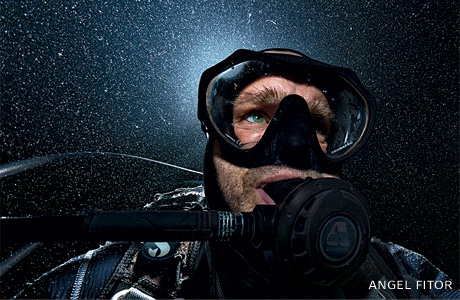
Making those images posed technical challenges that took Fitor years to overcome. To obtain his subjects, he tows a plankton net while swimming, diving, kayaking or motorboating in the Mediterranean Sea, sampling at depths ranging from the surface to 100 feet deep “to get the widest variety I can,” he says. Next, Fitor rushes the samples back to a specially equipped studio—either on a boat or in his home in the coastal town of Alicante, Spain—to keep them at the correct temperatures and levels of light and oxygen. He then uses a micropipette to extract individual seawater drops and look for interesting animals with binoculars—all before setting up his camera gear. It can take up to eight hours to make a single image.
His greatest challenge has been keeping the animals alive until they can be released back to the sea, a problem he’s largely solved, with “nearly zero losses.” Keeping his specimens alive “is not only about ethics,” Fitor explains. “I need the natural colors and behaviors of the living animals to keep the soul of my work alive.”
Avery Schuyler Nunn is a writer and photographer based in California. Read about Angel Fitor.
More from National Wildlife magazine and the National Wildlife Federation:
Whiz, Poop, Rot: How Whale Waste Helps Oceans Thrive »
Earth’s Largest Wildlife Migration Helps Fuel the Planet »
What Makes Organisms Glow »


