Nuclear Testing Continues in Nevada. Western Shoshone Want It to Stop.
Western Shoshone activists are protesting ongoing nuclear testing, plus the threat of expanded testing and nuclear storage, on land they say they never relinquished
- By Diana Kruzman
- Conservation
- Jun 24, 2026
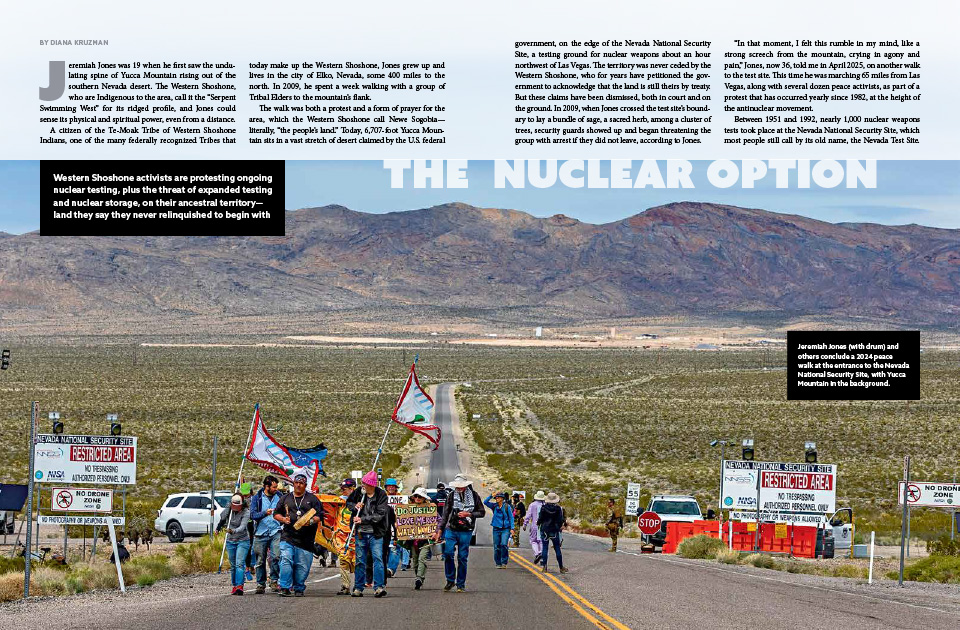
Jeremiah Jones (with drum) and others conclude a 2024 peace walk at the entrance to the Nevada National Security Site, with Yucca Mountain in the background. (Photo: ©Las Vegas Review-Journal, Inc. [2024], Used With Permission)
JEREMIAH JONES WAS 19 when he first saw the undulating spine of Yucca Mountain rising out of the southern Nevada desert. The Western Shoshone, who are Indigenous to the area, call it the “Serpent Swimming West” for its ridged profile, and Jones could sense its physical and spiritual power, even from a distance.
A citizen of the Te-Moak Tribe of Western Shoshone Indians, one of the many federally recognized Tribes that today make up the Western Shoshone, Jones grew up and lives in the city of Elko, Nevada, some 400 miles to the north. In 2009, he spent a week walking with a group of Tribal Elders to the mountain’s flank.
The walk was both a protest and a form of prayer for the area, which the Western Shoshone call Newe Sogobia—literally, “the people’s land.” Today, 6,707-foot Yucca Mountain sits in a vast stretch of desert claimed by the U.S. federal government, on the edge of the Nevada National Security Site, a testing ground for nuclear weapons about an hour northwest of Las Vegas. The territory was never ceded by the Western Shoshone, who for years have petitioned the government to acknowledge that the land is still theirs by treaty. But these claims have been dismissed, both in court and on the ground. In 2009, when Jones crossed the test site’s boundary to lay a bundle of sage, a sacred herb, among a cluster of trees, security guards showed up and began threatening the group with arrest if they did not leave, according to Jones.
“In that moment, I felt this rumble in my mind, like a strong screech from the mountain, crying in agony and pain,” Jones, now 36, told me in April 2025, on another walk to the test site. This time he was marching 65 miles from Las Vegas, along with several dozen peace activists, as part of a protest that has occurred yearly since 1982, at the height of the antinuclear movement.
Between 1951 and 1992, nearly 1,000 nuclear weapons tests took place at the Nevada National Security Site, which most people still call by its old name, the Nevada Test Site. Fallout drifted across Nevada and into Utah—a region home to around 5,000 Western Shoshone today. In 1990, the U.S. Congress acknowledged that people living in these areas, known as “downwinders,” received significant doses of radiation that experts believe have health effects to this day.
While the federal government agreed to end large-scale nuclear weapons tests in 1992, testing continues on a smaller scale underground. In recent years, a new generation of protesters, including Jones, has begun mobilizing against testing and renewed government efforts to store nuclear waste at Yucca Mountain, a plan that’s widely opposed by Nevada residents but has received past support from the Trump administration. (More recently, the Energy Department has turned its sights on other states, such as Texas and New Mexico.)
Though primarily driven by concerns about the effects of nuclear testing and waste disposal on the health of people and the environment, the protests are also part of something larger: the ongoing battle for Indigenous sovereignty in Newe Sogobia. The Western Shoshone are not only trying to get their land back, as are many Tribes around the country. They’re saying they never agreed to giving it away in the first place.
“We are still in the fight to have our land, our treaty and our rights recognized, because those are human rights violations,” says Fermina Stevens, a citizen of the Te-Moak Tribe of Western Shoshone and chairperson of the Noowuh Knowledge Center, a nonprofit library and archive in Elko. “The land is still ours.”

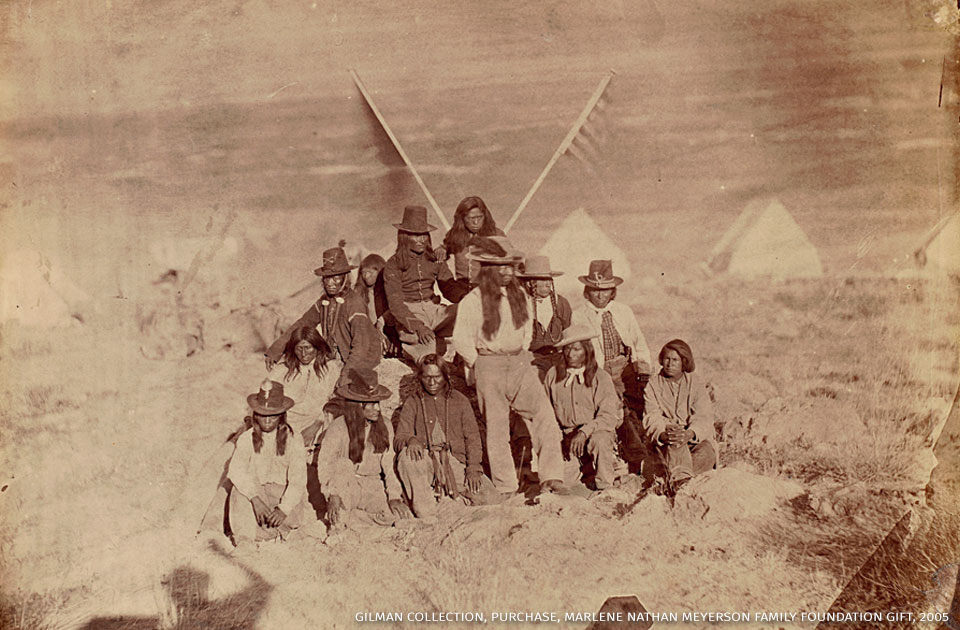
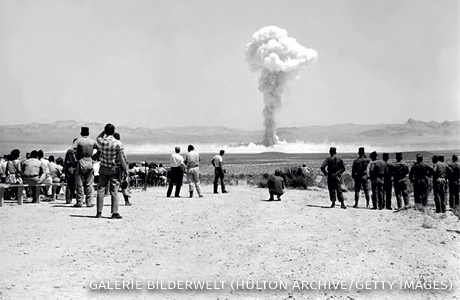
Western Shoshone men (pictured) pose sometime between 1867 and 1872, several years after the 1863 Treaty of Ruby Valley codified free land passage. A crowd (below) gathers to watch the so-called Small Boy nuclear weapons test on July 14, 1962—the final year of aboveground testing at the Nevada National Security Site, although subterranean testing continues to this day.
The first nuclear weapons test at the Nevada Test Site occurred on January 27, 1951, and continued aboveground for more than a decade. Curious tourists watched the mushroom clouds from the rooftops of Las Vegas hotels. The government assured residents that testing was safe and would only be conducted on calm days when the wind wouldn’t blow the fallout into nearby population centers.
Court testimony in subsequent lawsuits showed those plans failed to account for changes in the weather that carried a radioactive particle called iodine-131 into large swaths of Nevada, Utah and Arizona in the days after a test took place. The radiation traveled through the air and settled in the soil and water, where it was absorbed by grazing cattle that passed it along to people, including children, through the animals’ milk, according to a landmark 1999 report by the National Cancer Institute (NCI).
Part of the U.S. Department of Health and Human Services, NCI recognizes iodine-131 as raising the risk of thyroid cancer. Although it’s difficult to say definitively that radiation caused a specific person to fall sick, the institute has linked nuclear testing in Nevada to as many as 212,000 cancer cases.
After decades of advocacy, more than 40,000 downwinders received a one-time payment of $50,000 each from the federal government through the Radiation Exposure Compensation Act, or RECA. Despite limits to its scope, the 1990 law represented a breakthrough for people living in a 72,000-square-mile section of Nevada, Arizona and Utah who developed cancers and other health issues linked to radiation exposure. (RECA’s coverage area and payment amounts were roughly doubled in 2025 due to lobbying.)
And yet, for many Indigenous survivors and suspected victims of nuclear testing, RECA didn’t live up to its promises. Western Shoshone communities in northern Nevada, such as Elko, were not covered by the law, although Jones told me that many from his community hunted and ate animals that traveled freely between southern and northern parts of the state, representing risks unrecognized by the government.
Other Western Shoshone who did live within the coverage area found it difficult to navigate the law’s notoriously complex bureaucracy. Many living in poverty and rural isolation lacked the necessary documents to prove they resided in the areas covered at the time testing was being conducted, according to previous reporting by publications including High Country News.
No data exist on the total number of Western Shoshone potentially affected, as research on the effects of radiation exposure for Indigenous Peoples is particularly limited, says Abel Russ. Now an attorney at the nonprofit Environmental Integrity Project, Russ worked on a study of radiation exposure among the Western Shoshone from 2000 to 2006 as a research associate at Clark University.
“Some people, by nature of how they live their lives, are going to have a greater risk,” Russ says. Researchers who estimated how much exposure the average downwinder got from sources such as cow milk failed to account for Indigenous diets that incorporate large amounts of wild game, such as rabbits, which can lead to higher doses of radiation, he explains. His research found that Western Shoshone and other Indigenous communities received doses of iodine-131 several times higher than non-Native residents. Because iodine-131 isn’t a naturally occurring substance, there is no “safe” amount of exposure.
While iodine-131 has a half-life of just a few days, other contaminants from aboveground testing, such as plutonium isotopes, are longer lasting, posing health risks for thousands of years. These particles remain in the dust and can be kicked back up into the air by wind and other disturbances.
Animals and plants were likely affected, too—including those in the 2,500-square-mile Desert National Wildlife Refuge adjacent to the test site. Studies from the 1960s and ’70s found that blasts destroyed desert vegetation and deposited radiation in the bodies of desert bighorn sheep. But scientists have not been able to carry out longer-term studies because the government limits which parts of the refuge they can enter, says Kevin DesRoberts, who spent 18 years managing the refuge for the U.S. Fish and Wildlife Service. A 40-square-mile parcel has been closed to all access for decades due to nuclear contamination.
“We really don’t know how the testing that has occurred has impacted the habitats and species on the refuge,” explains DesRoberts, who retired last year. In addition to bighorn sheep, those species include Joshua trees, golden eagles, mountain lions and desert tortoises—with the latter listed as threatened under the federal Endangered Species Act. “How is the contaminated area impacting … their reproductive cycle, their behavior?” DesRoberts wonders.
After aboveground testing ended in 1962, the government continued subterranean nuclear tests for another 30 years, contaminating an estimated 1.6 trillion gallons of groundwater with radioactive isotopes like tritium, strontium-90 and cesium-137. (There currently are no known surface-water-related risks for humans, as it takes thousands of years for groundwater to filter upward.) Today testing continues underground at the subcritical level, meaning it isn’t large enough to produce a nuclear explosion. But the Western Shoshone are still protesting the site, seeking to prove not just that the test site is harmful, but that it is illegal.
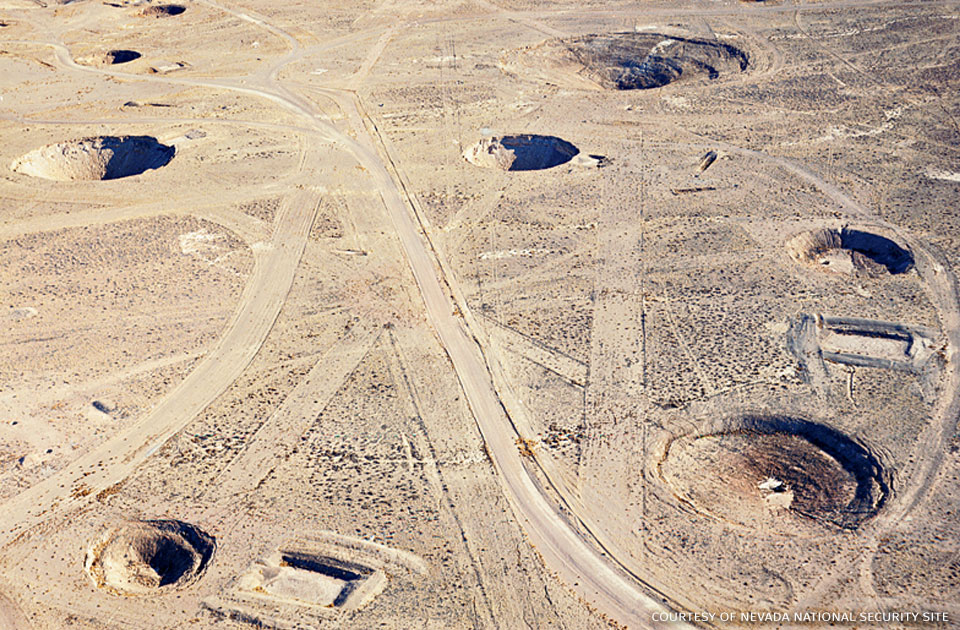
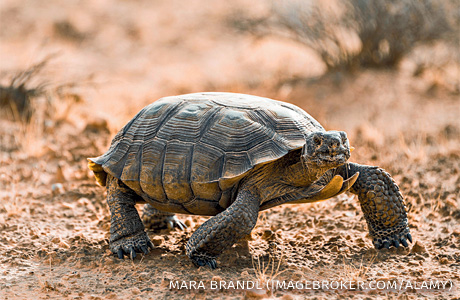
Craters from underground testing dot the landscape at the Nevada National Security Site (pictured). The decades-long closure of a 40-square-mile parcel of wildlife refuge adjacent to the test site has limited scientists’ knowledge of nuclear impacts on wildlife, including the federally threatened desert tortoise (below).
In 1863, as American expansion continued its relentless march westward, the federal government sought to protect settlers and military forces from attacks by the Indigenous Peoples whose lands they were expropriating. In October of that year, the governors of the Nevada and Utah territories—not yet states—signed the Treaty of Ruby Valley with 12 Western Shoshone leaders who represented different bands but were united by language and cultural traditions.
The treaty allowed Americans free passage through Western Shoshone lands but did not cede the territory to the United States, according to Seánna Howard, a professor in the Indigenous Peoples Law and Policy Program at the University of Arizona. The federal government nevertheless incorporated the land into the state of Nevada and established multiple federal public lands, including the future Nevada Test Site. (It also set aside land for the Great Basin Tribes, including the Western Shoshone.)
The seizing of land posed a conflict between the United States and the Western Shoshone—who, starting in 1951 with their inclusion in the Indian Claims Commission, tried to get that federal agency to recognize that the land was still theirs. In 1979 Congress appropriated $26 million to settle the Western Shoshone dispute, in effect barring future land claims, but the Western Shoshone refused the payout. Finally, in 1985, the U.S. Supreme Court ruled on the side of the government, deciding that Congress’ move to set aside funding in escrow counted as a legal end to Western Shoshone land claims, even if the Tribes did not accept the money.
Howard later represented the Western Shoshone in front of the Inter-American Commission on Human Rights as well as the United Nations’ Committee on the Elimination of Racial Discrimination. Although these bodies did not issue rulings on the Western Shoshone’s land claims, they did find the Indian Claims Commission process had violated international human rights standards. In a report issued in 2006, they recommended that the U.S. government work more directly with the Western Shoshone. (The Committee on the Elimination of Racial Discrimination also expressed concern about federal efforts to open a nuclear waste repository at Yucca Mountain.) So far, these recommendations have not been implemented, Howard says.
In the meantime, activists and leaders have collaborated with Western Shoshone communities on ongoing claims to the unceded treaty lands, including what is now the Nevada Test Site. Stevens of the Noowuh Knowledge Center organizes a yearly conference around the Treaty of Ruby Valley.
“Some Western Shoshone have forgotten that part of our history,” she says. “We’re trying to make more people aware of the human rights violations that have occurred and bring more people together so we have a larger fighting force.”
That’s a difficult task, Stevens says, because the Western Shoshone, spread across a dozen reservations and colonies in western states, are too fragmented and too preoccupied with daily survival to effectively engage in political organizing. But she takes heart in recent decisions affirming Indigenous sovereignty, such as a 2020 Supreme Court finding that most of eastern Oklahoma still belongs to Indigenous Peoples.
“We’re just thinking and hoping that maybe there is hope out there for our future, that we can make something happen,” she says.
Part of what has driven Stevens, Jones and other Western Shoshone activists to speak out is the ongoing threat of nuclear waste disposal at nearby Yucca Mountain. A 1982 law mandated that waste from the nation’s 57 commercially operating nuclear power plants, as well as from weapons facilities, be relocated to a site underground. But as of now the waste—which results from the processing of uranium and plutonium and risks leaking radioactive material into the environment if not secured properly—remains in temporary storage facilities around the country. In 1987, Congress designated Yucca Mountain as the only site to be evaluated as a geological repository, but Nevada residents, fearing the state’s air and water would be contaminated, rose up in protest.
Under the Obama administration, the Department of Energy abandoned plans to store waste at Yucca Mountain, but multiple ongoing lawsuits maintain the possibility that the plan could be revived. The likelihood increased when President Donald Trump’s energy secretary, Chris Wright, refused to rule out Yucca Mountain as a potential repository during his confirmation hearing last year. Trump attempted to restart funding for the project during his first term, although he later reversed course. Last October, he called for the “immediate” resumption of nuclear weapons testing, although it wasn’t clear whether he meant full-scale explosions or continuing subcritical underground tests. While he didn’t mention Nevada by name, it is the only nuclear test site operating in the United States.
For Jones, protesting the test site and potential waste disposal at Yucca Mountain is a way to assert the ongoing presence of the Western Shoshone on their ancestral territory and to remind Tribal members—just as much as the outside world—that these lands are still theirs.
“The goal is … to put a stop to it all, shut it down and not use that land” for testing, Jones says. “Because you’re on stolen land.”
Read about writer Diana Kruzman.
More from National Wildlife magazine and the National Wildlife Federation:
Copper Mine or Sacred Land: The Fight for Oak Flat »
Advanced Nuclear Energy: Impacts and Considerations »


