General Program Questions
The Eco-Schools program is built on two foundational tools, the Eco-Schools Framework, used globally by over 70 participating countries, and the Eco-Schools U.S. themes, wildlife and biodiversity, climate, and healthy and resilient communities. A successful Eco-Schools program utilizes both tools when working toward or maintaining excellence in environment and nature-based educational experiences and practices at the intersections of the environment, economy, and society.
Each year, you collaborate with key members of your school community, including students, teachers, principals, other school staff, district administrators, families, and community members and partners, to create an action plan and apply for certification by completing the actions outlined in the plan. Schools build an Action Team to accomplish each action, and the results of each action are recorded in the online Eco-Schools Certification Application (ECA) to earn points. At the end of the school year, your certification application is assessed, and a certification level ranging from Bronze to Green Flag is awarded.
For more information, check out the Certification Guide and the What is Certification? page.
First, you’ll want to familiarize yourself with the program: What is Certification?
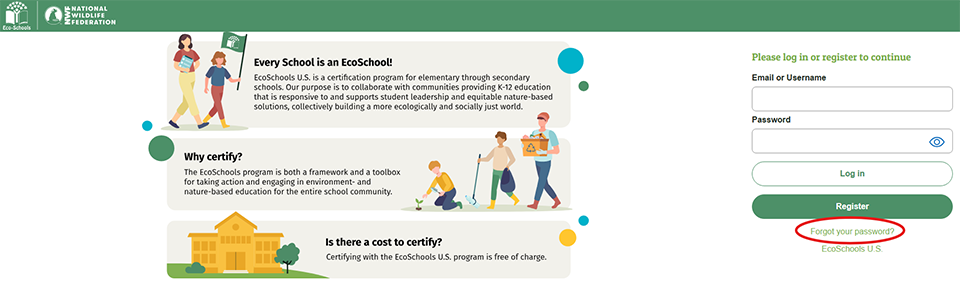
Once you’re familiar with the program, the next step will be to register on the Eco-Schools Certification Application (ECA) platform. See: New users – How to register
Then, you will be able to review the various Eco-Schools actions and start curating your plan for the year.
Throughout the school year, schools complete actions in their online application (ECA) and earn points towards their certification. The depth and extent of these completed environmental and nature-based actions will determine the school’s final certification level.
There are four levels of certification a school can achieve: Bronze, Silver, Gold, and Green Flag. Any school that creates a plan on the Eco-Schools Certification Application but is unable to submit for certification (a minimum of 50 points) will be recognized as a Participant school if they have earned at least 35 points and submit their plan for approval.
When a school becomes a certified Eco-School, they receive a digital certification seal that reflects their certification level. This seal can be displayed on a school’s website and social media accounts, in newsletters, in email signatures, and more.
Before you begin implementing any action, make sure to review the following criteria:
Do no harm. Consider if this action may unintentionally hurt other people, animals, or environments. Research best practices and exercises to do with your students that are helpful in determining the root of a problem.
Leave it better than how you found it. For example: pick-up litter, remove invasive species, plant native, pollinator-friendly flowers, and consider consumption behaviors to reduce waste.
Environmental connection. Ensure there is a clear connection to the environment and community. This may include one or more of the following:
- Maintaining social and ecological integrity
- Ensuring resource efficiency and maintenance
- Pursuing equity within, and between, generations
- Mitigating and preventing environmental issues
Adapted from: Robert B. Gibson (2005) Sustainability assessment: Criteria and process. Earthscan.
Intersectionality, equity, and inclusion. Does this action respect the diverse experiences and identities of people within your school community? In the global community? Would anybody be left behind or be marginalized by this action? Does the action provide dignity and solidarity? Does the action provide for free, prior, and informed consent and respect the sovereignty of Indigenous peoples.
Aligned with Eco-Schools U.S.’ organizational values. See here for more information on our mission and values.
- Registration for Eco-Schools certification opens on August, 10th each school year. Registration is open to all schools in the U.S.
- The submission period for certification begins the first Friday in April and ends the first Friday in June. This means dates will be updated yearly to reflect the calendar and to keep opening and closing dates from occurring over the weekend.
- NOTE: Schools aiming for Green Flag certification must complete the Green Flag Eligibility Questionnaire by the last Friday in February. The questionnaire is aimed at assessing readiness, not completeness.
- Schools aiming for Participant, Bronze, Silver, or Gold recognition can register with the program at any time before the final deadline—though we suggest starting earlier in the school year to ensure there’s enough time to create and implement your action plan, and update your online application.
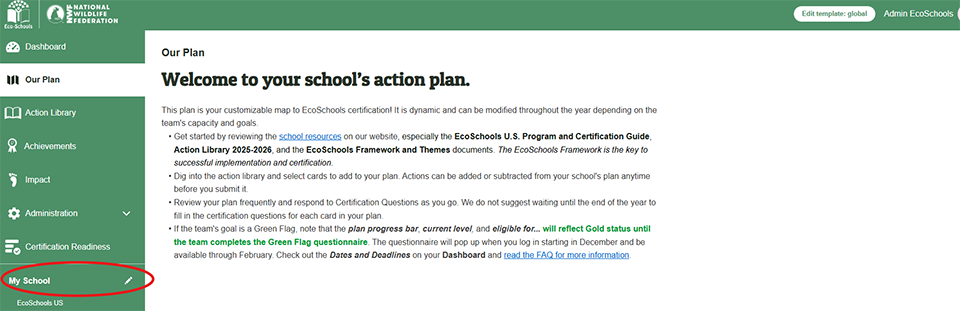
When you log in to the Eco-Schools Certification Application (ECA), you will be able to explore the action library. Each action is connected to relevant worksheets and resources that can be used to support your Eco-Schools program.
Consider connecting with local experts including Indigenous elders and community leaders, environmental organizations, businesses, and your municipality.
Members of your school community may have specialized expertise to support your program; try to connect to families and community members to see how they can assist with different parts of your program.
To engage more teachers and students, consider all the ways the program can be connected to classroom lessons, extra-curricular activities, or individual interests.
Some examples:
- Have different classrooms complete actions connected to a unit of study (i.e., science, civics, and language arts classes).
- Think of how you can turn a common school event waste-free like a staff meeting or school dance.
- Engage people based on their strengths. For example, have an art teacher help with poster designs, or an administrator to approve field experiences.
- Connect to regional priorities and community needs.
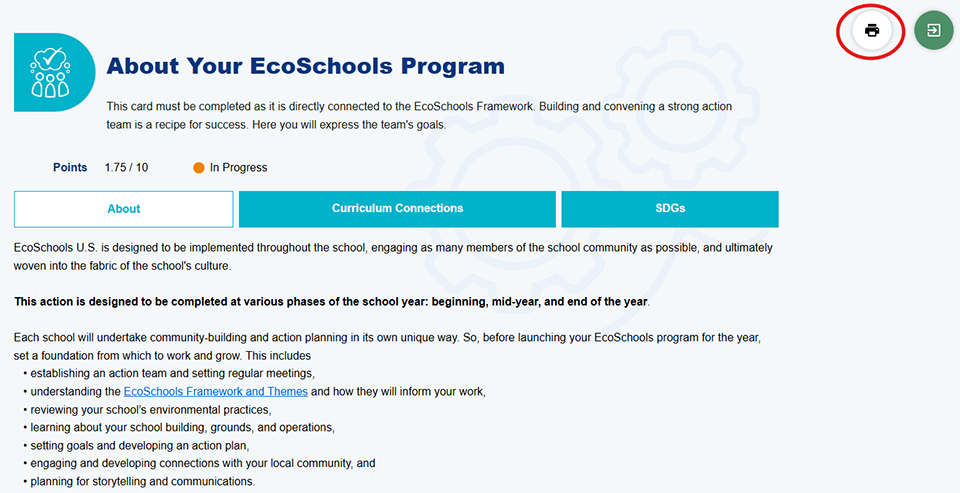
Within each Eco-Schools action on the ECA, there is an “Curriculum Connections” section. It includes suggestions on how to connect your Eco-Schools actions beyond a specific environmental issue to broader topics, questions, or causes (e.g., a community issue, the climate justice movement, reconciliation, etc.). Below, we have provided some additional guidance and resources for extending the learning in your Eco-Schools program.
The Eco-Schools program is structured around individual actions such as planting a pollinator garden or encouraging active and sustainable transportation to and from school. While each action can be completed on its own, the greatest impact comes from a holistic and equitable approach to learning and action on environmental issues that are relevant to your school and community. Eco-Schools encourages all participants to extend the learning of each action by exploring how it might connect to other actions, fulfill community needs, relate to deeper themes of social justice, or otherwise support broader causes. Choosing to connect environment-based learning with state-based required content may be a powerful way to spark student inquiry, encourage personal growth, and foster a sense of stewardship for your school’s social and ecological communities.
Curriculum connections can happen before, during, and after an action. As part of the Eco-Schools U.S. Framework, curriculum suggestions will be provided in every action in the ECA.
As an organization, Eco-Schools U.S. is constantly striving to learn and unlearn by connecting our work to broader projects of environmental justice, inclusion, and reconciliation – we are with you in the learning journey!
Have a resource or idea that you think we should know about? Please send it our way: ecoschoolsus@nwf.org.
The Eco-Schools program is free. All schools are encouraged to implement the program at their own pace. Resources are available to registered schools only. Certification is highly encouraged. Eco-Schools not meeting certification requirements will be recognized as Participant schools.
The Eco-Schools logo can be downloaded below.
Logos can only be used by participating schools and approved partners.
As a certified or participating school, you can download and use digital Eco-Schools logos on websites and social media to showcase your participation in the Eco-Schools program.